Can artificial intelligence assist in sermon preparation without undermining authenticity, theological reflection, or the preacher’s own voice? These questions are increasingly being discussed in churches around the world as AI tools become more accessible and sophisticated.
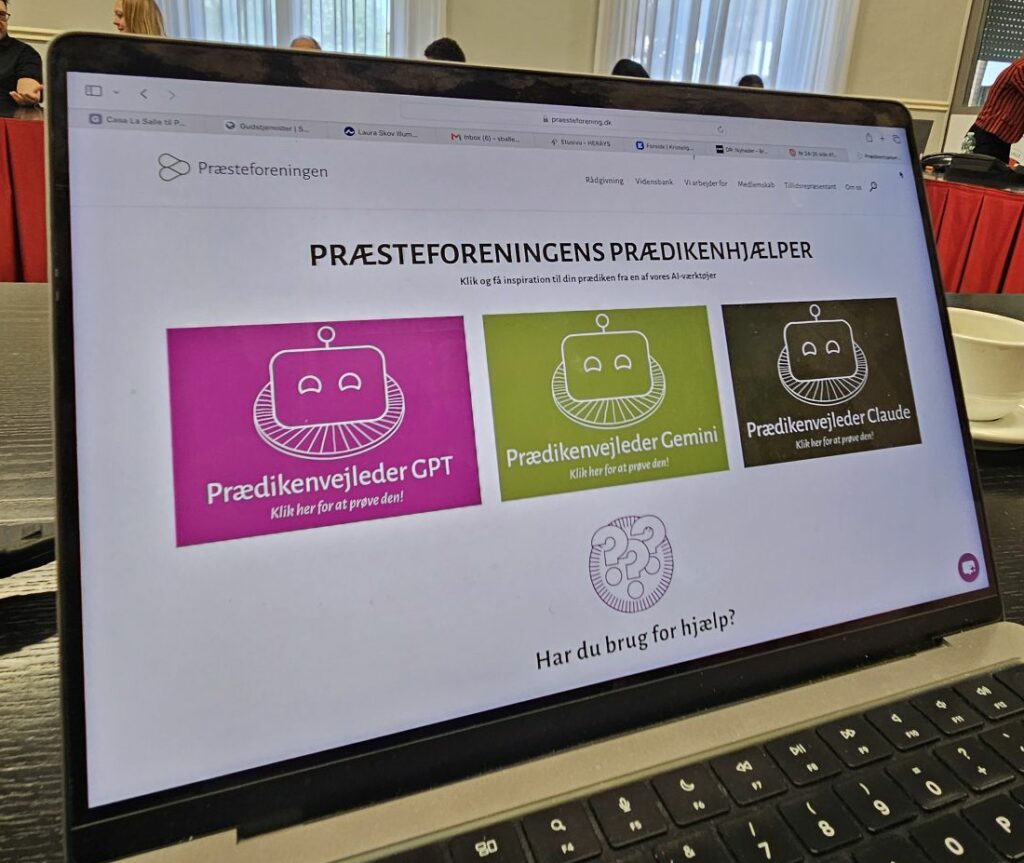
One notable example is the Prædikenhjælper („Sermon Helper“), an AI-assisted platform developed by the Danish Pastors‘ Association (Præsteforeningen). The platform provides access to several large language models, including GPT, Gemini, and Claude, adapted to support sermon preparation within the Lutheran tradition.
During the European Christian Internet Conference (ECIC), held in Rome from 10–12 June 2026, I spoke with Simon Nøddebo Balle about the opportunities and challenges of AI-assisted preaching. Balle is a Lutheran parish pastor in Aarhus and holds a PhD on artificial intelligence. Drawing on both pastoral experience and academic expertise, he reflects on how Danish pastors use the Prædikenhjælper, the ongoing debate surrounding AI in ministry, and whether AI can be a meaningful aid in sermon preparation.
Interview with Simon Nøddebo Balle
Have you used the sermon helper of the Danish Pastors‘ Union yourself?
I’ve used it a few times, both this and other LLMs.
Did you find it helpful?
I find it helpful for generating ideas and sometimes for structuring ideas against each other. At the same time, I find it a bit limiting compared to other chatbots on the market. The constraints are there by design. It’s trained to follow a certain tradition, an Evangelical Lutheran one, and it has a lot of additional training on top of being a standard model. That is a strength, but can also be limiting at times, so I tend to use it alongside other tools.
Have you used it mainly for exegesis and idea generation, or have you also used it to write sermons?
I don’t think the generated sermons themselves are that great. For me, it’s more of a shortcut into the tradition and a way to see what other pastors have preached on a particular subject. Part of the training data consists of a vast number of sermons from the Church of Denmark. That’s basically what I use it for.
So it’s more like a research tool.
You could say that. It’s a unique one because it has access to a specific body of material that other models don’t have. I don’t use it much for exegesis. There are better tools for that. I mainly use it as a way of engaging with the local tradition of the Church of Denmark.
Are there regulations concerning the use of AI in the Danish Folkekirken? If so, do pastors have to disclose that they have used AI?
No. We have neither restrictions nor recommendations, and there is no centralized requirement to declare whether AI has been used. It’s entirely up to the individual pastor. Some pastors have even delivered completely AI-generated sermons, observed how the congregation reacted, and then asked people for their opinions afterwards during coffee after the service.
If you use AI yourself, do you make that transparent to the congregation?
Only if I’m asked. I don’t think I use it heavily enough that I should proactively disclose it. I also don’t declare whenever I borrow ideas from colleagues, which I think happens often among pastors. And I think there’s some truth to the quote often attributed to Albert Einstein saying that “true creativity is about knowing how to hide your sources.” If you have to attest every single time you use an idea, formulation or train of thought from someone else in a sermon, it would be terribly unpleasant to listen to.
Do you know colleagues who regularly use the sermon helper to generate sermons?
I don’t know anyone who uses it regularly for that purpose. The people who have tried generating complete sermons have mostly done so out of curiosity or as an experiment to see how the congregation would react. Most colleagues use it to generate ideas or to get feedback on their own sermon drafts and see how they might improve them.
When the sermon helper was launched, it received a lot of publicity.
It certainly received a lot of mostly negative feedback.
I remember seeing headlines such as „Sermons from Hell.“ Do you think the amount of attention was justified, or is it simply one tool among many commercially available tools?
When an institution with so many members in Danish society introduces a tool like this, it’s entirely appropriate that it receives attention and is discussed in the media. I welcome that debate. Much of the coverage was negative, but that’s often what attracts readers. Questions of authenticity and trustworthiness are important because they influence how people perceive the church. We need to take those concerns seriously and explain how and why we use these tools. People should understand that we take sermon preparation seriously. We draw on our own lives as well as the sources available to us. We don’t use AI simply to avoid the work. We try to prepare as thoroughly as possible in order to deliver a good sermon.
Has the possibility of generating sermons with AI changed the way you preach? For example, do you use more examples from your personal life because that is something AI cannot provide?
I don’t think it has changed my preaching style. If anything, I’ve used it to find examples from world literature or other sources that broaden the perspective. My sermons were already strongly shaped by my own religious practice and experiences. That wasn’t really an issue for me, but I understand why people ask the question.
Is AI a topic of discussion among your colleagues?
Definitely. Whenever pastors gather within the deanery, the topic comes up. Some colleagues are firmly opposed to using AI, while others use it more regularly.
Do those who use it do so openly?
Yes, I think the people who use it are generally very open about it. At least where I live, there is also a noticeable generational difference.
Do you think it is genuinely helpful to have a tool like this, or could you easily do without it and use commercial tools instead?
I could certainly do without it and rely on commercial tools. That would be a slight impoverishment, perhaps, but it wouldn’t be a major problem. We don’t need it, but it’s good to have access to as much help as possible.
Some people argue that a generic Lutheran sermon is preferable to a generic sermon from any other source because at least it remains Lutheran. Is that important to you?
I haven’t thought much about that before. On reflection, I don’t think so. I have a great deal of confidence in my colleagues. I think they are capable of taking whatever a commercial model produces and interpreting it in a Lutheran way. They have the training and good judgment to do that.
The interview has been lightly edited for readability.